Change Blindness: Why You Miss What AI Quietly Edits
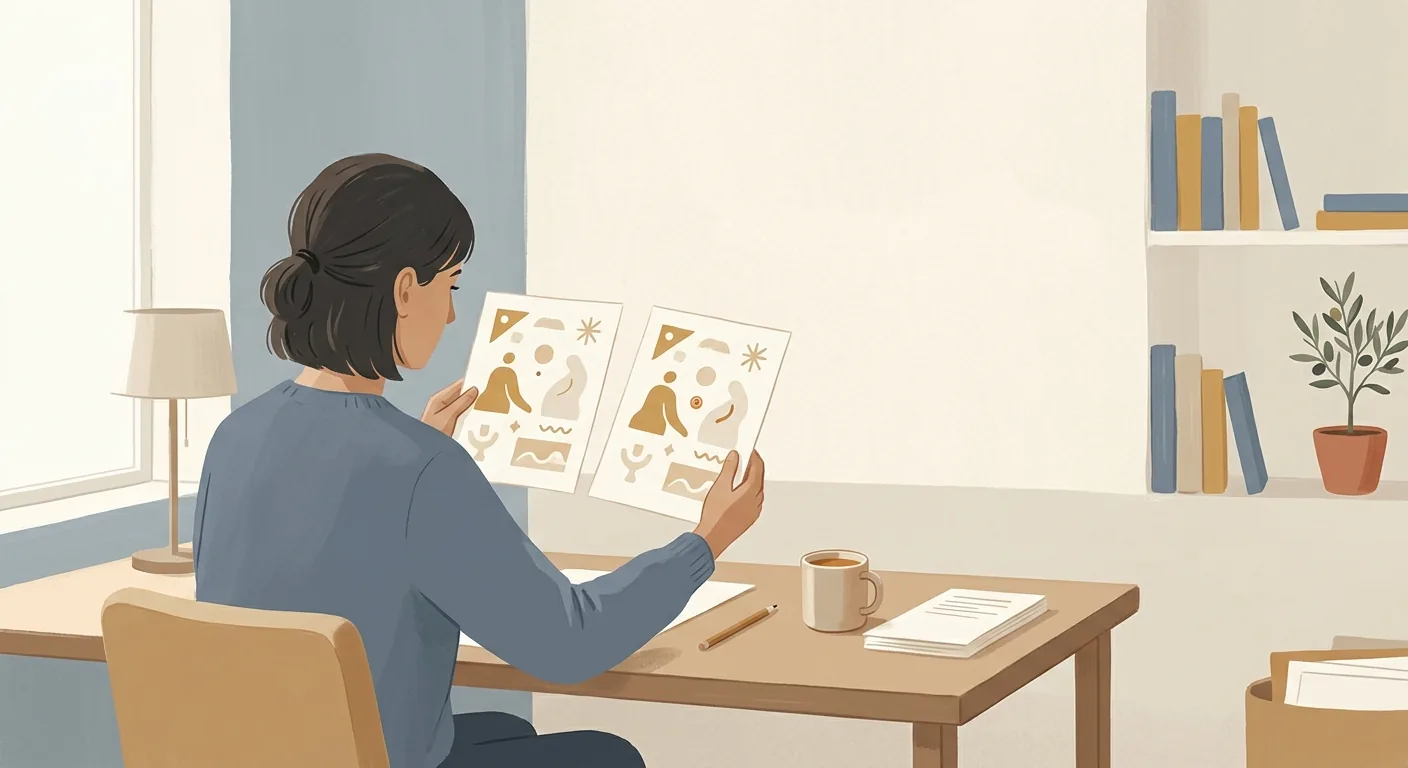
A large new study finds intelligence and personality barely predict who catches an unexpected change, and an eye-tracking study shows people look right at a small edit and still miss it. Here is why that matters when reviewing what an AI just changed.
A large new study finds that intelligence and personality barely predict who catches an unexpected change, and an eye-tracking study shows people look right at a small edit and still miss it. That is change blindness, and it is a limit of attention, not a personal failing. When an AI rewrites your work, the small quiet edits are the ones that slip past, so the fix lives in the workflow, not in trying harder.
A maker I know shipped a paragraph last week that an AI had tidied up for her. She read it twice. It looked clean. Two days later a colleague pointed out that somewhere in the smoothing, the tool had changed a figure from 12 to 21. She had looked straight at that sentence. She did not see it move. That small miss has a real name in the research, and a study published this month says something uncomfortable about who it happens to.
What Change Blindness Is
Change blindness is the everyday failure to notice that something has changed between a before and an after, even while looking right at it. Its close cousin, inattentional blindness, is missing an unexpected thing entirely while focused on something else. The classic demonstration of inattentional blindness is the one where people counting basketball passes fail to see a person in a gorilla suit stroll through the middle of the scene. Both are limits of attention, not of eyesight.
This month, Daniel Simons, one of the researchers behind that gorilla experiment, and three colleagues published a registered report in an open-access Royal Society journal. A registered report is a study whose plan is locked and reviewed before any data comes in, which makes the result hard to massage after the fact. They ran the two largest studies of their kind, about a thousand people each, to answer one question: can we predict who notices the unexpected thing? The answer was humbling. Cognitive ability predicted noticing only weakly and inconsistently. Personality barely predicted it at all. There is no reliable “good noticer” trait to hire for, or to be.
What Small Changes Look Like With Numbers
Here is what change blindness looks like with numbers on it. Earlier this year, researchers tracked the eyes of 120 people spotting changes in QR-code images. Large, obvious changes were caught most of the time. Small ones were caught about a third of the time. And the eye-tracking caught the cruel part: people fixated right on the changed spot and still answered “same.”
"In total, 64.8% of modified QR codes were identified, with greater detection for larger changes (92.6%) than smaller changes (37.0%)."
This is the same shape as the verification tax on AI code that engineering teams keep running into: the cost is not reading the output, it is actually seeing it. It is the same reason a mixed human-and-AI workflow scrambles your sense of who wrote what, and the same blind spot that hides the gap between an AI’s confidence and its accuracy.
Neither Study Was About AI or Reviewing Output
Neither study was about AI, work, or reviewing a document. One used a gorilla-style task, the other used QR codes. The bridge to reading an AI’s edits is mine, not theirs, and that is worth saying plainly. The QR study leaned on older adults and a pattern most of us never scrutinize for a living. The big new study measured who notices in a lab, not whether any training closes the gap in real work. So treat this as a strong description of a human limit, not a measured fact about a Tuesday inbox.
The useful part survives every caveat: small changes are the dangerous ones, and no one can out-smart the miss. "I will just be more careful" is precisely the move the data says will not save anyone.
When You Accept an AI Edit at a Glance
So the leverage is not in being a sharper person. It is in the workflow. Notice the moment you accept an AI change after a single glance, especially when the edit is small and the prose around it reads fine. That is the moment the research is pointing at. Big rewrites earn attention on their own. The one swapped number, the flipped name, the quietly dropped “not,” those slip through because nothing about them feels like a change. Make the small diffs loud, and give the boring edits the slow, deliberate second pass they never seem to deserve.
None of this means trusting the tools less or trusting ourselves more. It means knowing where the eyes lie, and building one honest checkpoint where they do. That is a small practice, and it holds.
Sources
- Do individual differences in cognitive ability or personality predict noticing in inattentional blindness tasks? - Royal Society Open Science, 2026-06-01
- Spot the difference: Investigating the effects of ageing on change blindness in QR codes with eye tracking - Computers in Human Behavior Reports, 2026-01-22
Written by Kinan Hamwi, Founder of Cerevisor.