How to Evaluate an AI Coding Agent When the Control Plane Changes Weekly
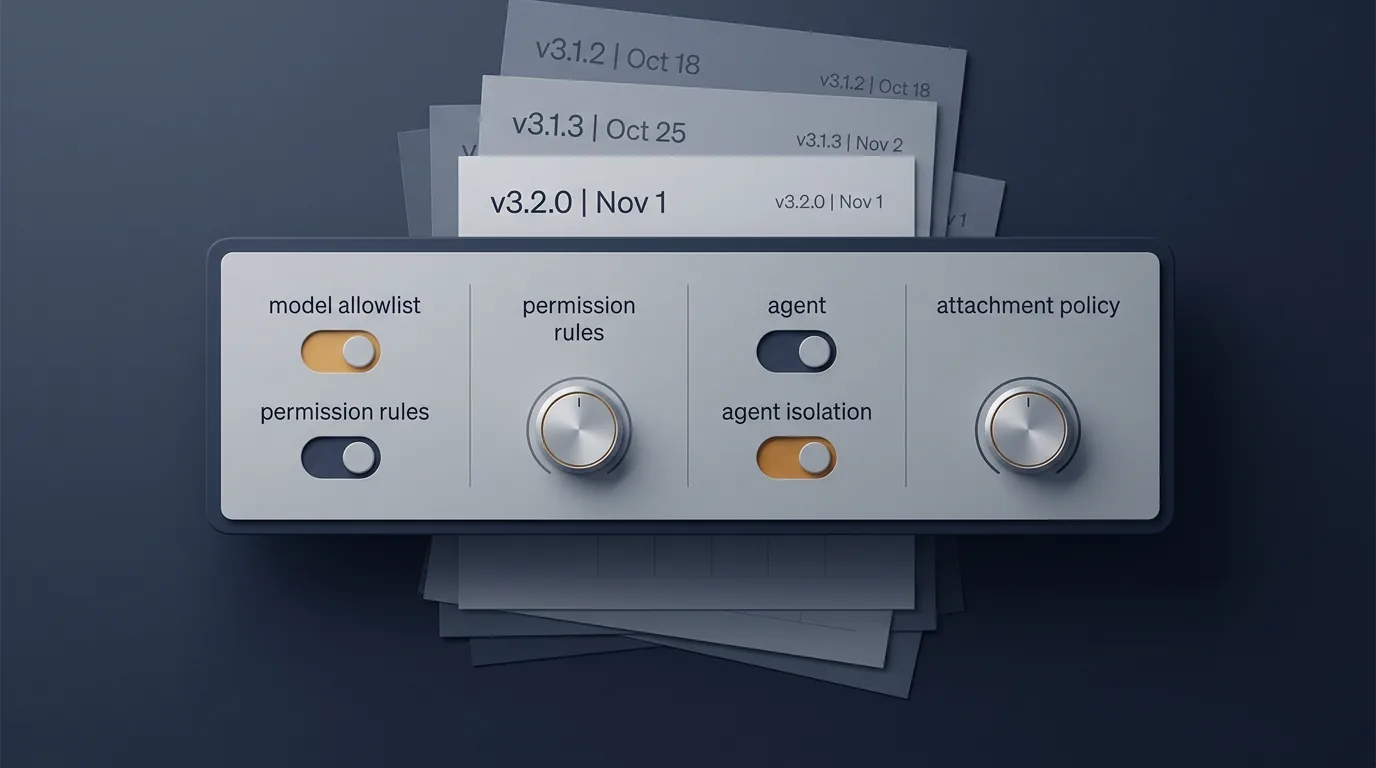
In three days this week the major coding-agent harnesses shipped almost no new model capability and a wave of governance primitives instead. Here is how to evaluate an AI coding agent when the surface being bought changes release-over-release.
This week the major coding-agent harnesses shipped almost no new model capability. They shipped governance instead: settings that constrain which model a developer can pick, permission rules that match on tool parameters, isolation that puts an agent on its own VM and branch, and policy gates on what an agent is allowed to attach. The thing actually being evaluated is the control plane, and it now changes release-over-release. A bakeoff scored on this week's feature set is stale in a fortnight.
I went through the release feeds for the past three days expecting another round of model bragging. That is not what landed. Across Claude Code, Cursor, and GitHub Copilot CLI, the shipped surface was almost entirely about control: who can run which model, what a permission rule is allowed to match on, where an agent runs, and what it can pull into context. Not one of those is a benchmark number. Every one of them is a governance decision that can only be tested against a team’s own rules.
That is the whole problem with picking an AI coding agent right now. The part that matters is moving, and it is moving on a weekly cadence.
Why a model bakeoff is the wrong harness test
Most harness evaluations still get scored like a 2024 model bakeoff: run the same task set through two tools, see which writes better code, sign the bigger contract. That test answers a question the vendors already settled. The models are close enough that the model is rarely the deciding factor anymore. The deciding factor is the governable surface around the model, and this week made that almost comically literal.
Claude Code v2.1.176 added an enforceAvailableModels managed setting that constrains the default model inside an allowlist, where user settings cannot widen the managed list (Releasebot, June 16). Two days later, v2.1.181 introduced a Tool(param:value) permission syntax that matches on tool input parameters, so an admin can write a rule like blocking Opus from subagents (Releasebot, June 18). Cursor v3.7 shipped a /in-cloud command that spins up a subagent in its own VM and branch so the local workspace stays clean (Cursor changelog, June 17). GitHub Copilot CLI v1.0.63 made blocked image attachments explain that vision has to be enabled by policy (release feed, June 16).
None of that is a model upgrade. All of it is the surface a team operates, and it changed four times in three days.
An evaluation that scores the model is grading the part that barely moves and ignoring the part that changes weekly. Score the harness, not the model.
How to evaluate an AI coding agent this week
Here is the playbook I would run if I were re-opening a harness decision right now. It is built to survive the next four releases, not just this one.
-
Write the rules down before touching a tool
List the governance facts the org actually needs: which models are allowed, which actions need a human, where agents may run, what they may read. That list is the fixed reference. The harness is graded against it, not against a public benchmark.
-
Test the model-constraint layer, not the model
Can an admin force a default model and stop a developer from widening it? Claude Code's `enforceAvailableModels` does exactly this (Releasebot, June 16). Try to break it from a user account. If it holds, that is a real control. If there is no such setting, write that down as a gap.
-
Probe the permission grammar against a real parameter
The new `Tool(param:value)` syntax matches on what a tool is called with, like blocking Opus from a subagent (Releasebot, June 18). Pick a rule worth enforcing and try to write it. A harness whose permissions only match tool names, not parameters, is a coarser instrument than one that matches both.
-
Run one task in isolation and watch where it executes
Use Cursor's `/in-cloud` or the equivalent to put an agent on its own VM and branch (Cursor changelog, June 17). Confirm the blast radius is the branch, not the laptop. Isolation nobody can see is isolation nobody has.
-
Try to feed the agent something it should refuse
Attach an image or a file the policy should block. Copilot CLI now tells you a blocked attachment needs vision enabled by policy (release feed, June 16). The useful signal is whether the harness gates ingestion at all, and whether it explains the gate to the developer instead of failing silently.
-
Name a re-trigger, not a renewal date
Pick the event that forces a re-evaluation: a new managed setting, a permission-model change, a default that flips with nobody setting it. Assign one owner to watch the feed and call the re-test. This is the step that keeps a stale scorecard from becoming a stale decision.
The bakeoff is stale before the contract is signed
The common mistake looks responsible. A team runs a careful two-week bakeoff, scores both harnesses on a shared task set, picks a winner, and files the result like it is durable. Then within the same procurement cycle, three of the features they scored have shifted and two new governance primitives have shipped that were not in the test at all.
The bakeoff is not wrong. It is just measuring the slowest-moving part of a fast-moving thing. The model quality one team benchmarked is roughly the same model quality the competitor benchmarked, and it will be roughly the same in a quarter. What changes underneath is the control plane, and the default nobody sets is the default the vendor sets.
The question is not which AI coding agent wins the bakeoff. It is which governable surface a team can keep grading after the bakeoff is over.
The second mistake is treating the harness like a frozen SKU. Nobody is buying a finished product here. The thing on the contract is a surface the vendor will keep reshaping, on their cadence, often without a release note that lands on anyone’s desk. That is not a reason to panic. It is a reason to make re-evaluation a standing job with a name on it, instead of a one-time event that ends when the contract is signed.
Governance tooling and the 12x production gap
I want to be honest about the evidence here, because the strongest statistic I have is not from this week. It is older, and I am flagging it as background rather than fresh news.
"Companies using AI governance tools get over 12 times more AI projects into production."
That line is from a Databricks piece in January, drawing on their own customer base, so read it as a vendor’s framing of their own data, not an independent benchmark. The same piece noted that organizations using evaluation tooling moved nearly six times more AI systems into production. I would not put either number on a board slide as gospel. What I will say is that the direction matches what shipped this week: the governable, evaluable surface is where production actually lives, and the harness vendors are now competing on exactly that surface.
The number that should anchor the decision is not in any of these reports. It is the one a team generates in-house: how many of those written-down governance rules can this harness actually enforce, tested against a real account, today. Four out of six is a real answer. “It writes good code” is not.
Open the rules, not a benchmark, on Monday
Monday morning, do not open a benchmark. Open the rules. Write the short list of governance facts that need to be true, then sit with whichever harness is the front-runner and try to make each one true from an admin account. Force a model. Write a parameter-level permission rule. Run a task in isolation and watch the branch. Feed it something it should refuse.
Then do the one thing the bakeoff never includes: name the person who watches the release feed and calls the re-test when a default changes. The harnesses proved this week that the surface moves on a weekly clock. An evaluation should have a heartbeat too, and right now that is the most useful thing on the whole scorecard. If you do only one thing from this, make it that name.
Sources
- Claude Code Updates by Anthropic (Releasebot) - v2.1.176 and v2.1.178 - Releasebot, 2026-06-16
- Claude Code Updates by Anthropic (Releasebot) - v2.1.181 - Releasebot, 2026-06-18
- Cursor Changelog v3.7 (cloud agent dev environments, /in-cloud subagents, snapshots, local-cloud handoff) - Cursor, 2026-06-17
- GitHub Copilot CLI v1.0.63 (vision-policy gating of image attachments) - GitHub Copilot CLI release feed, 2026-06-16
- Enterprise AI agent trends: top use cases, governance, evaluations and more - Databricks, 2026-01-27
Written by Kinan Hamwi, Founder of Cerevisor.