One coding-agent harness or a portfolio? The decision Build 2026 just reframed
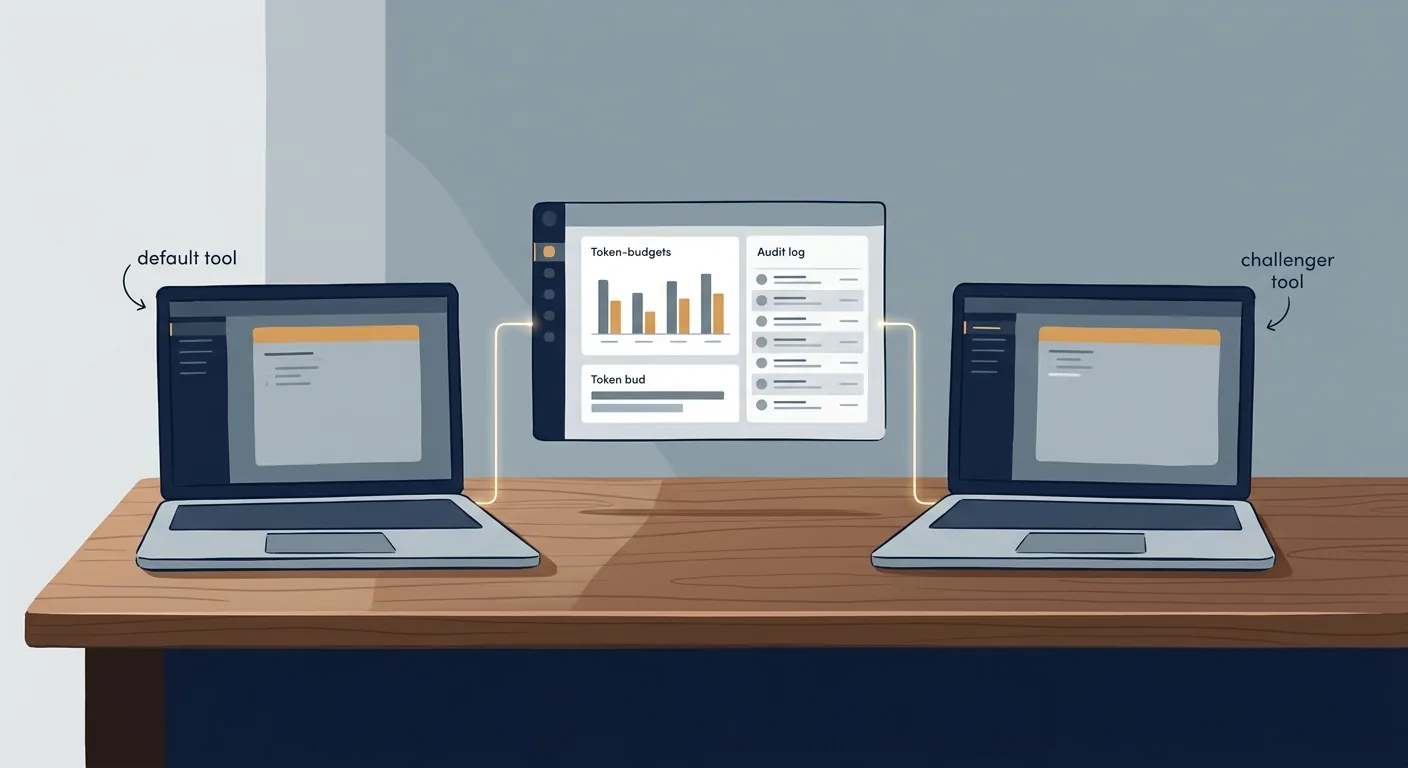
Standardizing on a single coding agent felt like the safe, conservative call. Build 2026 and the June 1 billing switch quietly turned it into the concentrated one. Here is the decision that actually holds.
This week the "which single coding agent should we standardize on" question quietly stopped being the right question. The model under GitHub Copilot is set to change to Microsoft's own Project Polaris in August, billing went fully metered on June 1, and the same agent skills now run across both Copilot and Claude Code. The durable decision is what to standardize at the governance and portability layer, then run a small deliberate portfolio on top of it.
The problem this solves
I had three different founders ask me the same thing last week, in slightly different words: do we just pick one coding agent and make everyone use it, or do we let teams run a few? Fair question. Standardizing feels clean. One vendor, one bill, one training session, one tidy line on the board slide.
Then Build 2026 opened in San Francisco on Monday, and the question aged about a year in three days.
Here is the short version of why it matters. The thing most teams believe they are standardizing on, the harness, is not the thing that actually decides cost, capability, or risk. Those three moved this week, independently, and none of them waited for a procurement cycle.
The approach
Start by pulling apart two layers that get collapsed in almost every one of these conversations.
The harness is the tool an engineer opens: Claude Code, Cursor, GitHub Copilot, Codex. The substrate underneath is the model, the cost meter, and the governance plane. People debate the harness because it has a logo and a demo. The substrate is the part that decides whether the bet holds.
Build 2026 made the gap impossible to miss. Microsoft unveiled Project Polaris, its own in-house coding model, set to replace GPT-4 Turbo as the default reasoning engine inside GitHub Copilot starting in August, with an optional three-month fallback, per ChatForest’s recap on June 2. Read that twice. A team that standardized on Copilot last quarter did not standardize on a model. The model under the harness is scheduled to change, and the brand on the invoice stays exactly the same.
Cost moved on the same calendar. On June 1, Copilot’s billing went fully usage-based: the same headline seats, $19 for Business and $39 for Enterprise, now sit on top of a token meter where one AI credit equals a cent, softened only by promotional credits of $30 and $70 a month through August. The reaction was loud, and the math is the reason.
"Developers who run agentic workflows are facing community-reported increases of 10x to 50x, with extreme cases far higher."
The governance layer, the part that actually contains all of this, is where the real standardization quietly showed up. Azure AI Foundry shipped per-project token budgets with consumption alerts and a least-privilege check on every single tool invocation, per the Windows News and ChatForest coverage. That is the substrate doing the work people hoped the harness choice would do for them.
The thing worth standardizing is the layer that survives a model swap and a price change. That layer is governance and portability, not the harness brand.
Portability got its own quiet proof point at Build. Microsoft showed WinUI agent skills running across both GitHub Copilot and Claude Code, the same skill, two harnesses. Technobezz reported the benchmark behind it on June 1: a 25% performance improvement for the WinUI 3 File Explorer component, with 41% fewer memory allocations and 45% fewer function calls. The headline there is not the percentages. It is that the skill was portable in the first place.
You are not choosing a coding agent for the next two years. You are choosing what stays constant while the agent underneath keeps changing.
Why most teams get this wrong
There are two traps, and they sit on opposite ends.
The first is treating “standardize on one” as the safe, conservative choice. A year ago, it genuinely was. Today, betting the whole org on a single vendor’s stack means inheriting that vendor’s model swap, that vendor’s pricing change, and that vendor’s governance defaults, all on that vendor’s timeline. That is concentrated, not safe. The Polaris change is the cleanest example I have seen: the harness held still while the engine under it got swapped out from a date on Microsoft’s calendar, not yours.
The second trap is the overcorrection. Letting every team run whatever they like and calling it a portfolio. That is not a portfolio, that is a shrug with a budget line attached. A real portfolio has a thesis: a default harness most work runs on, and a challenger you keep live precisely so you are never trapped when the default’s substrate moves. Two harnesses, on purpose, with an owner and an exit criterion for each.
The calm part, and there is one, is that the work to get this right is mostly the work you can do without any vendor in the room. Budgets, audit, portable skills. None of it requires a bakeoff.
The numbers
Three dates are now on the same wall. June 1: Copilot’s meter went live, $19 and $39 seats unchanged but variable token cost on top. August: the default model under that same harness changes. And the window in between is exactly when a team should be deciding what it standardizes on, because the answer “the harness” no longer covers either change. Microsoft’s own framing at Build put per-transaction agent cost reductions of up to 40% on the table, which only sharpens the point: the cost curve is a moving target, so the control has to live in the budget plane, not the seat count.
Ship it
-
Name the layer you actually standardize on
Write it down: governance plane (budgets, audit, least-privilege) plus portable artifacts (skills, rules, MCP config). That is the standard. The harness is a choice you make on top of it, not the foundation.
-
Run a deliberate two-harness portfolio
One default, one challenger. Each gets a named owner and a written swap criterion. The challenger is not indecision; it is the thing that keeps a model swap or a price change from becoming an emergency.
-
Put a ceiling on the meter before the next bill
Set a per-engineer monthly token ceiling and a per-project budget with an alert. The June 1 switch means an unbounded harness is now an unbounded invoice. Bound it this week, not after the first surprise.
-
Calendar the model swap
Polaris lands as Copilot's default in August. Put a re-evaluation date on the calendar now, with a named owner, so the change is a scheduled review and not a Monday-morning discovery.
-
Keep the artifacts in your repo, not the vendor's
Skills, rules, and config live in version control where they move between harnesses. Portability is what turns a forced migration into a config change instead of a rebuild.
The honest read on this week is that the vendors are dissolving the “pick one” question faster than any committee could answer it. That is not a problem to fear. It is permission to stop agonizing over the logo and start standardizing the parts that actually hold still. Pick a default, keep a challenger, govern the meter, and let the model underneath change on its schedule while the team barely feels it. That is a decision that survives August.
Sources
- Microsoft Opens Build 2026 in San Francisco with Agent Mode as the Default for Office 365 Copilot - Technobezz, 2026-06-01
- Build 2026: Microsoft's Platform Shift to AI Agents, Copilot, and Azure AI Foundry - Windows News, 2026-06-01
- GitHub Copilot Moves to Usage-Based Billing: developer backlash - Let's Data Science, 2026-06-01
- Microsoft Build 2026 Recap: Windows Agent Platform, Project Polaris, Copilot Workspace - ChatForest, 2026-06-02
Written by Kinan Hamwi, Founder of Cerevisor.