What Everyday Awe Does for Attention in an AI Workday
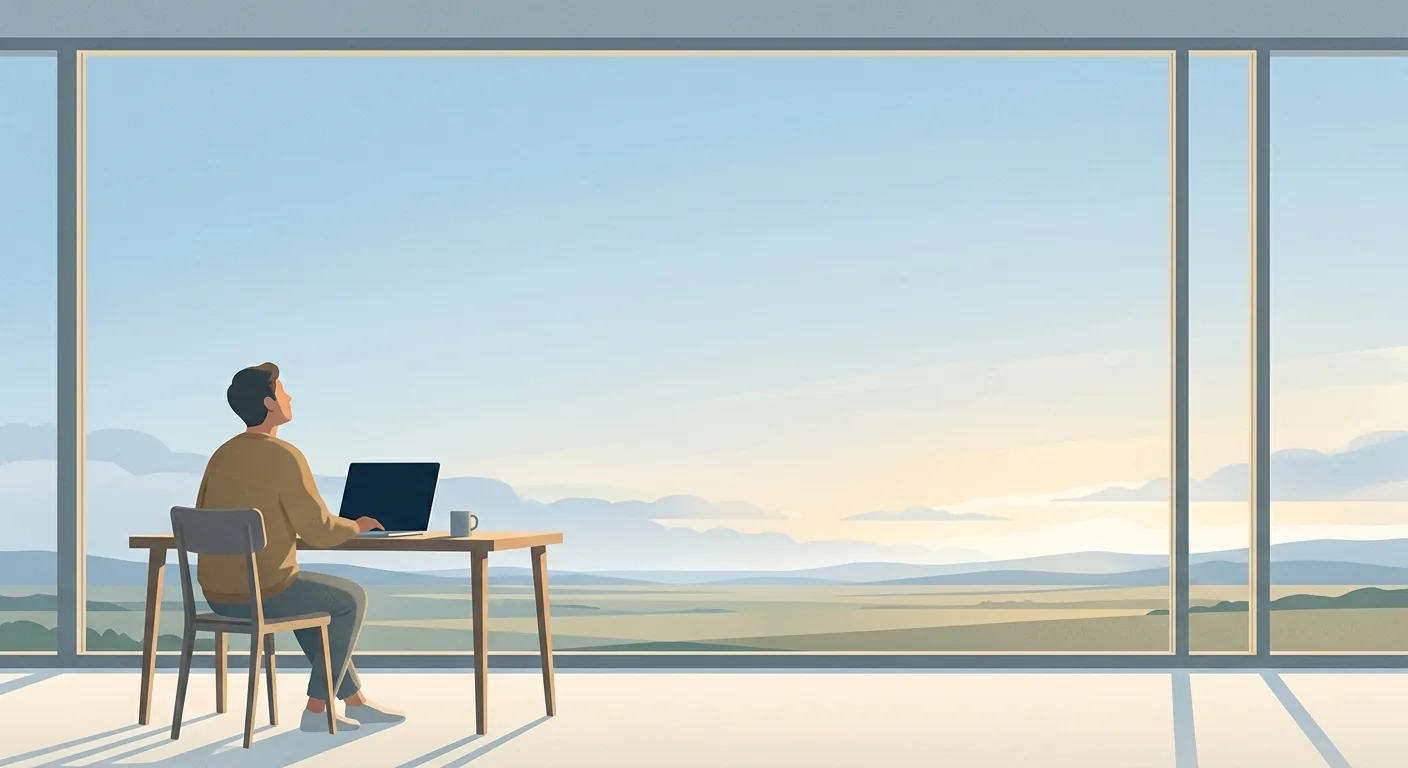
A fresh daily-diary study found people felt a little less alone on the days they noticed more awe than usual, with a felt sense of connection as the thread. Awe needs a beat of open attention, and a workday paced by instant AI answers fills those beats before they arrive.
A fresh daily-diary study found people felt a little less alone on the days they noticed more awe than usual, even after accounting for other good moods. The thread that explained it was a felt sense of connection to something larger. Awe needs a beat of open, outward attention, and a workday paced by instant AI answers tends to fill those beats before they arrive. The thing worth noticing is whether anything bigger than the next task got a few seconds of attention today.
A developer I know described her afternoon as a fast back-and-forth with the tool. Draft, read, accept, re-prompt, again. When she finally looked up, she realized she had not looked at anything farther away than her monitor since lunch. Not the window, not the street, nothing with any real size to it. The day had been full and somehow flat. That flat feeling turns out to have a research-shaped explanation, and a study published earlier this year put numbers on part of it.
What everyday awe did across 9,624 daily reports
Earlier this year, a team led by the psychologist Dacher Keltner published a study in the journal Scientific Reports on awe in ordinary life. Awe is the feeling of running into something vast that does not quite fit the frame you brought to it: a wide view, a piece of music that opens up, a kid saying something truer than expected. The researchers asked 171 healthcare workers and 306 other adults to keep a short daily diary for 22 days in a row, close to ten thousand daily reports in all.
On the days a person noticed more awe than usual, they reported feeling a little less alone that same day. The link held after the researchers accounted for other good moods, so this was not simply happy people feeling connected. It showed up again in the second group. The thread that explained it was a sense of connectedness, the feeling of being part of something bigger than yourself. That is the same quiet capacity behind the research on positive solitude, where chosen time alone tracked with more support, not less.
"The final sample included 171 healthcare workers, contributing 3,412 daily observations, and 306 community participants, contributing 6,212 daily observations."
Awe was not just a good mood. It carried a specific ingredient, the felt sense of being part of something larger, and that ingredient was what tracked with feeling less alone.
What the awe study doesn’t prove yet
One study, and a careful one, is still one study. The effects were small, and the researchers say so plainly. The diaries were kept in June 2020, during lockdown, which was its own strange season for feeling alone. The design can show that awe and lower loneliness moved together on the same days. It cannot prove that one caused the other. And here is the honest seam: this study was not about AI at all. Nobody in it was reacting to a chat window. The line from “awe needs open attention” to “an AI-paced day crowds that attention out” is mine, not the data’s. Worth saying out loud before anyone builds a habit on it.
How instant answers fill the openings awe needs
Awe needs a small opening: a beat of attention pointed outward, at something with some size to it. The instant-answer default is very good at filling those openings. A blank moment used to sit there until something larger wandered in. Now it gets a draft in nine seconds. So the thing to notice is not “feel more awe,” which is not how awe works. It is narrower than that. Across one day, did anything bigger than the next task get a few seconds of attention. A long look out a window counts. So does the empty moment you would normally fill, the one the boredom research called not-waste. There is nothing to do with the noticing. Just see whether the day left any room for it. The room is small and easy to miss. It is also, most days, still there.
Sources
- Experiencing awe in daily life is linked to lower loneliness - Scientific Reports, 2026-02-23
Written by Kinan Hamwi, Founder of Cerevisor.