Recognizing yourself comes down to four moves: draft before you prompt, name your stance, protect one unassisted hour, and notice the gap before you ask.
Across seven weeks and forty-six posts, the work did not leave your day; it moved from generating a thought to judging one the model already made, and that second act is the part of the mind we are worst at noticing. What slips is not speed but authorship, source-memory, and the felt sense that the work was yours. Below: what is actually shifting, the signals that name it, the tensions you already feel, the moves to try this fortnight, and the one thing worth watching next.
66 ms vs 26 ms The inward turn back to a half-formed thought of your own costs 66 milliseconds; the outward turn to the screen costs 26. AI lives almost entirely on the cheap, outward side. The figure comes from earlier lab experiments surfaced in technostress-ai-attention-inward-outward-builder, which is candid that reading it as a measured AI-attention result is a reasonable extension, not a proven finding.. Why AI Keeps Your Attention Pointed Outward at Work
- 95% Lost source memory. The AI Memory Gap: When Your Ideas Stop Feeling Like Yours
- 1 in 7 Acute oversight fatigue. Why AI Brain Fry Comes From Oversight, Not Delegation
- 37% Small AI edits noticed. Change Blindness: Why You Miss What AI Quietly Edits
A meta-view of Cerevisor self-awareness and technostress posts (46 posts, 2026-04-29 to 2026-06-15). Last updated 2026-06-15. Next refresh 2026-07-15.
Fact-check: approved_with_patches. Dual-verified by source hunter + math auditor. 1 consensus flag(s), 3 patch(es) applied.
The shift: from Generating a thought, holding a question to Supervising output, judging fast
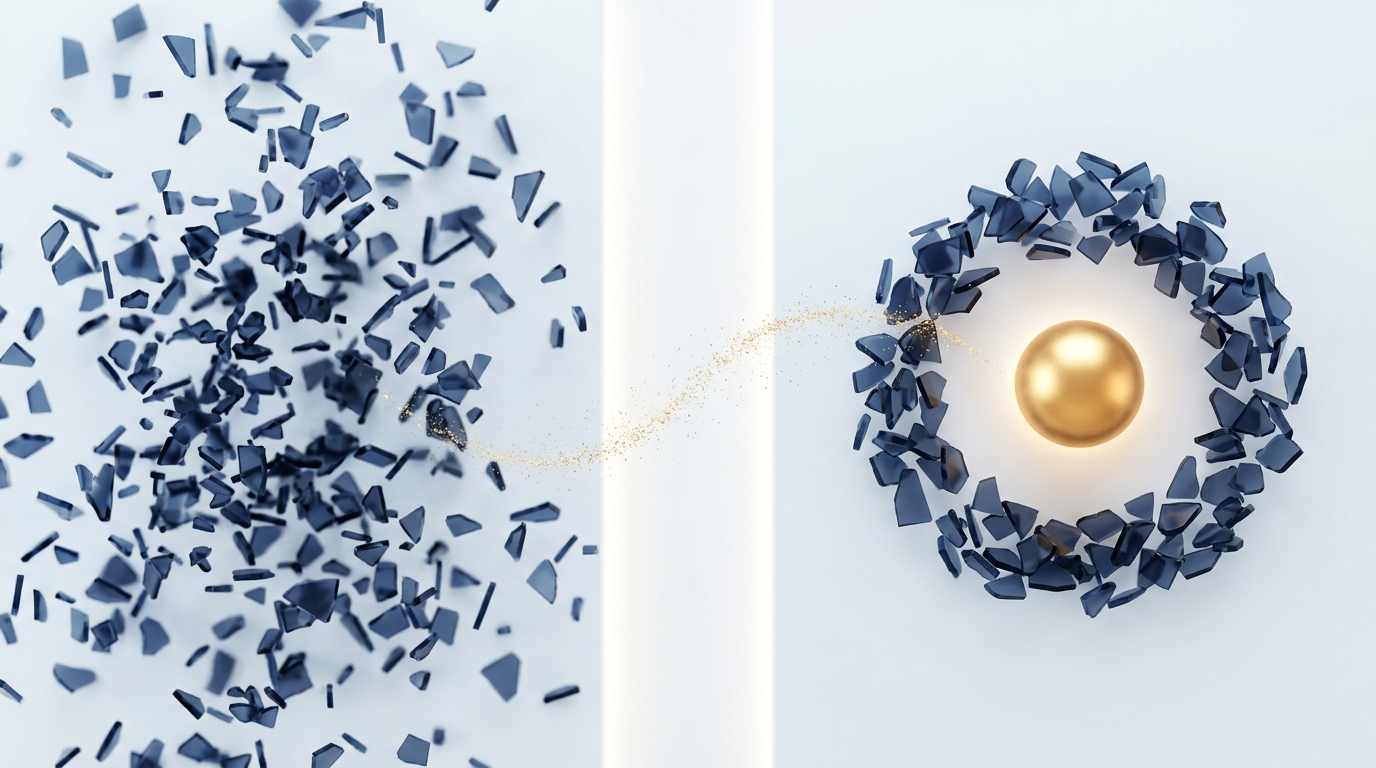
The center of cognitive gravity in knowledge work has moved from generating a thought to adjudicating one the model already made, and inner life is reorganizing around the second act faster than we have words for it.
You might already notice it: the day stays full, but the part that feels like yours has gone quiet. The corpus across these seven weeks keeps returning to one mechanism, not one symptom. When drafting, first-pass synthesis, and the typing itself move into the model, what is left for you is judgment, scope-keeping, and integration, and that residue is a different load than generation. ActivTrak telemetry on 163,000 workers puts the average focused session at 13 minutes 7 seconds against an organization now running seven AI tools, and Sophie Leroy's attention-residue work explains why each handoff is a fresh switch whose cost compounds rather than clears (ai-assistants-team-attention, technostress-ai-agents-attention-residue). The BCG and Harvard Business Review finding that one in seven AI users report acute fatigue from oversight rather than delegation names the same thing from the inside (technostress-ai-brain-fry-oversight-not-delegation). The second layer is not throughput; it is authorship, and the corpus isolates mode of use as the variable, not AI presence. Copy-paste workflows lower ownership, self-efficacy, and meaning while draft-then-refine does not (copy-paste-ai-sense-of-authorship). Underneath both runs an attentional asymmetry the later posts name precisely: turning attention outward to the screen costs 26 milliseconds, turning it inward to a half-formed thought of your own costs 66, and AI lives almost entirely on the cheap outward side (technostress-ai-attention-inward-outward-builder). This is the shape of the change: speed and confidence rise on the leading edge while metacognition, originality, source-memory, and the quiet signal that you count slip on a lag long enough that no quarterly review catches it. So what does this mean for you, working with AI all day. The corpus points at small moves, not a tool inventory. Draft one paragraph by hand before any chat tool opens, because sequence is the variable copy-paste damages and draft-then-refine protects (copy-paste-ai-sense-of-authorship). Name your stance before each session, since whether you actually scrutinize an output tracks the stance you hold, not the time you have (technostress-ai-partner-stance-scrutiny-builder). Protect one uninterrupted hour with every ping off, because the first switch of each block is the costly one and a single notification slows thinking by about seven seconds (ai-switching-drains-focus-leader-research, ai-notifications-attention-hijack-builder-research). And notice the half-second before you reach for the agent, the gap where the decision used to form (ai-decision-ownership-moral-responsibility-leader). None of these ask you to put the tools down. They keep the part of the work that keeps you.
The old reflex artifacts
- Generating Originating the thought by hand. What Copy-Paste AI Does to Your Sense of Authorship
- Holding A question open through the gaps. Why AI Keeps Your Attention Pointed Outward at Work
The new reflex artifacts
- Supervising Output the model already made. Why AI Brain Fry Comes From Oversight, Not Delegation
- Judging fast On the cheap outward turn. Why AI Keeps Your Attention Pointed Outward at Work
Data signals
- 95% lower odds | CHI 2026, n=184 - A week later, you cannot reliably tell whose idea was whose. When an idea came from the tool but you did the elaboration, the odds of correctly attributing it a week later fell 95 percent, and the feeling that it was mine was almost uncorrelated with whether it was.
- d = 0.509 | CHI 2026, NUS, n=92 - One short personal conversation drifts your self-concept toward the model's traits. After a single 5-to-15-minute conversation about personal topics, self-concept aligned toward the chatbot's displayed personality at a medium effect size, and the longer the conversation, the larger the drift.
- 37% vs 92.6% | eyes on the spot - Trying harder to catch a small AI edit is the move the data says fails. Only 37 percent of small changes were spotted versus 92.6 percent of large ones, even with eyes resting on the changed spot, and intelligence and effort barely predicted who caught them.
- 1 in 7 | n=1,488 | Mar 2026 - Oversight, not delegation, is what is tiring you. About one in seven AI users report acute mental fatigue from AI use, and the mechanism named is the work of watching AI work, landing the same season agentic mode shipped into Word, Excel, PowerPoint, and ChatGPT.
- 86% | Rosebud CARE benchmark - Leading chatbots surfaced tallest-bridge information after an indirect self-harm hint, 86% of the time. On the Rosebud CARE benchmark, leading AI chatbots gave tallest-bridge information following an indirect self-harm hint 86 percent of the time without registering the underlying risk, which is a named-source measurement worth holding even though it sits off the day's main thread.
Unresolved tensions
- Feeling sharper while being less sharp: Felt: AI co-use produces immediate, durable subjective gains in speed, fluency, and confidence within days. vs Measured: metacognitive accuracy, originality, and source-memory silently slip, and a week later people cannot tell whose idea was whose.. The two signals do not merely differ, they diverge: a Frontiers in Artificial Intelligence study found chat-model confidence pinned near the ceiling regardless of accuracy, and the CHI source-attribution work found 95 percent lower odds of recalling whose idea it was when human elaboration rode on a model's seed. Optimizing on the felt signal misprices the lagging one until it surfaces as an originality or judgment gap. Evidence: ai-assistants-team-attention, ai-confidence-vs-accuracy-builder-research, ai-memory-gap-source-attribution-builder.
- Delegation is light, oversight is heavy: Felt: agentic defaults across Office, Workspace, and ChatGPT promise to remove the cost of generation. vs Measured: picking the right candidate from AI options draws hardest on attentional inhibition and cognitive flexibility at once, and only 37 percent of small edits are caught even with eyes on the spot.. The workday is changing shape under the same name: a week judging 100 drafts is not the neural load of a week writing 10, even when the dashboard shows similar output. Change-blindness research closes the trap, because the cheapest-feeling oversight is exactly where quiet errors pass. Evidence: ai-options-cognitive-control-attention-builder, ai-switching-drains-focus-leader-research, ai-change-blindness-reviewing-output-builder.
- The mirror that shapes back: Felt: persistent memory makes the AI feel like a stable interlocutor that remembers and reflects you. vs Measured: a single 5-to-15-minute personal conversation drifts self-concept toward the model's displayed traits at d = 0.509, larger the longer it runs.. The corpus treats identity as a loop phenomenon formed in the back-and-forth, not a fixed inner property, so a loop that now includes a model with its own statistical tendencies is doing some of the forming. Self-concept clarity surfaces as the protective resource, built by ordinary reflection the chat window is built to fill before it starts. Evidence: technostress-ai-chatbots-self-image-research, technostress-ai-identity-research-every-leader, technostress-self-concept-clarity-steady-leader.
- The stance decides, not the speed: Felt: the intuitive fix for thin AI scrutiny is more time, slower review, fewer tools. vs Measured: across 912 workers, whether someone actually checks an output tracked the stance held toward the tool, not how much time they had; being in a hurry did not switch the checking off.. Relating to AI as a partner switched scrutiny on while relating to it as an answer machine left it off even with time to spare, and a separate survey of writing professionals found those who held the rival and partner stances together kept both the productivity gain and the skill. The lever leaders reach for, time, is the wrong one; the lever that works, stance, is invisible on every dashboard. Evidence: technostress-ai-partner-stance-scrutiny-builder, technostress-ai-rival-or-partner-writers-builder-research.
This-week practices
- Draft one paragraph by hand before any chat tool: Copy-paste-first use measurably lowers ownership, self-efficacy, and meaning, while drafting first and bringing AI in to refine shows no ownership drop at all (copy-paste-ai-sense-of-authorship). The lever is sequence, not abstinence, and the gap before the answer is where your decision used to form (ai-decision-ownership-moral-responsibility-leader). This week: Block the first 20 minutes of every drafting task this week as a chat-tools-closed window. Open a blank document, write one paragraph by hand answering the central question, then bring AI in only to refine or critique what you already wrote. Mark which days you held the sequence and which you broke it. copy-paste-ai-sense-of-authorship
- Audit which AI answer felt least like yours: A single 5-to-15-minute personal conversation aligned self-concept toward the chatbot's displayed traits at d = 0.509 in the CHI 2026 study, and persistent memory now makes those conversations continuous by design (technostress-ai-chatbots-self-image-research). The drift is quiet from the inside, so the only way you notice it is to look on purpose. This week: Set a recurring 5-minute Friday calendar hold called 'Voice audit.' Open the week's longest AI threads or AI-assisted docs, copy the one passage that felt least like something you would have written, and paste it into a running journal under a single prompt: 'What about this is not me, and what shifted in me to accept it?' Keep the entries together so the drift becomes visible across weeks rather than vanishing into each thread. How AI Chatbots Are Quietly Reshaping Your Self-Image
- Protect one uninterrupted hour with every AI ping off: Focused sessions have collapsed to roughly thirteen minutes because each agent launch and notification is a fresh switch with a residue cost, and the first switch of every block is the expensive one (technostress-ai-agents-attention-residue, ai-switching-drains-focus-leader-research). A single notification slows thinking by about seven seconds even when nothing on it can be read (ai-notifications-attention-hijack-builder-research), and the unfilled gaps are exactly where solitude and savoring register (ai-solitude-working-mind-leader). This week: Place one recurring 60-minute calendar hold each workday titled 'No-agent hour,' before lunch if you can. During it, close every AI tool, silence agent-side notifications, and stay on a single open question by hand. At the end, jot a 1-to-5 on how absorbed the hour felt, so the pattern becomes visible across the week. Why AI Agents Make Workplace Focus Harder, Not Easier
What to watch
- Replication of the NUS self-concept drift finding in a longitudinal, multi-session study with persistent memory enabled. (H2 2026): The d = 0.509 figure comes from a single short conversation. The open question is whether the drift compounds, plateaus, or reverses across weeks of continuous memory, now that memory ships across consumer products by default. Trigger: A follow-up CHI, CSCW, or Nature Human Behaviour paper with N greater than 200 and at least a 4-week persistent-memory exposure window, or a public release of longitudinal memory-team data from Anthropic, Google, or OpenAI.
- A named field replication of an attention-residue or switch-cost intervention that holds up in agentic-tool environments. (Q3 2026): The corpus flags that lab fixes for switch cost did not cleanly replicate in a recent field experiment, which leaves the 13-minute focused session as an unmitigated trend. Whichever intervention replicates first will reshape how teams schedule agent-paired work. Trigger: A preregistered field study from Microsoft Research, ActivTrak, or an academic lab showing significant focused-session recovery in workers using five or more AI agents, published as a working paper or peer-reviewed article.
- An enterprise study pairing self-reported AI productivity gains against blind-rated originality, judgment, or source-memory. (Q3 2026): The Wharton PNAS Nexus result (10,462 participants, lower originality and lower recipient adoption from LLM learning) and the CHI source-attribution work need an at-scale enterprise analog before the lagging cost can be priced against the leading gain. Trigger: A McKinsey, BCG, Stanford HAI, or MIT release pairing matched self-report with blind-rated output samples across an at-scale Copilot or Claude deployment cohort.